Monday, 12 August 2013

LESSONS FROM THE SWAT VALLEY

A LESSON IN SPEECHMAKING AND COURAGE
 
The world has just received an unforgettable lesson from a sixteen-year-old - in both speechmaking and in courage.

Malala Yousafzai was already a great communicator and already a heroine when she stepped onto her school bus in Pakistan's conflict-riven Swat Valley last October.

She had become internationally famous for running her campaign to combat the Taliban's insane drive to prevent education for girls.

She was already the youngest ever nominee for a Nobel peace prize.

But when the Taliban sent what most be the must be the most inept assassin of all time to silence both her and her campaign, they not only failed spectacularly.

They managed to propel Malala's status as a heroine and superstar to stratospheric heights.

After the attack Malala came to Britain for a multiplicity of life-saving operations involving a titanium plate in her forehead and an implant in her ear.

She has since left hospital and resumed her campaign for female education at a level which must give anyone afraid of women - such as the Taliban - the worst of nightmares.

So it was fitting that Malala celebrated both her recovery and her sixteenth birthday, not with the conventional wild teenage party, but with a speech to the United Nations in New York. 

Mala at the UN
Malala speaking at the UN

GET YOUR MESSAGE ACROSS - WITH SIMPLICITY AND POWER 

Apart from Malala's obvious rare courage and determination, there are several ways that her UN speech is to be admired from a performance perspective.

And we don't have to have the world as our audience in order to pick up invaluable tips from her presentation skills.

For a start she had a clear message...something that all speeches need, but many lack.

Malala's message was that education is not the problem which the Taliban fear - it's the solution.

She didn't want to retaliate against the Taliban with the same crude kind of weapon they used on her.

Malala said that even if she had a gun in her hand and the Taliban representative who shot her was standing in front of her she wouldn't pull the trigger.

I believe her.

Instead Malala declared: "Education is the only solution."

And she wrapped up her message in a powerful image with the simplest of wording: "One child, one teacher, one book and one pen can change the world".

Many are fearful about giving a talk to a small number of people in their own company or to a panel of prospective buyers.

Malala addressed international leaders and the world beyond with a calm inner confidence based on the quiet unpretentious certainty which underpins the wisdom of her approach.

And rather than dwell on her own troubles and pain, Malala focused her attention on the challenges of others.

It was all done with an overwhelming positivity.

Malala spoke slowly with confidence, clarity and courage.

The couple of times she made a teensy verbal slip she kept cool and then came up with the correct version.

Check out Malala's style:

  
BECOME AN INSPIRATIONAL CEO IN TWELVE HOURS
I work with a lot of chief executives - en mass in business leaders groups and individually.

While they naturally have a wide range of personality types, there are a couple of things they tend to share.

Most of them tend to be quick, ambitious learners.

And they have the kind of brains that can keep across a wide range of things simultaneously.

One thing a lot of them are not so good is communicating in a clear, confident and inspiring way.

Up until recently the one-to-one work I do with chief executives has tended to be rather ad hoc.

I typically come in and work with them for a specific speech they have to make or a particular set of questions they have to face in the media or from their clients, prospects, shareholders, suppliers or staff.

But over the past week several chief executives, in the space of 24 hours, pushed me to design a more comprehensive programme to help chief executives rapidly boost their communications skills in a short period.

So I have listened and acted.

I'm now offering a new one-to-one programme for company leaders: "BECOME AN INSPIRATIONAL CEO IN 12 HOURS"

I know it's possible to achieve this because when I've worked with company bosses on their communication skills in a concentrated way over several sessions they've made mindblowing progress.

And I know that for many company leaders, being more inspiring communicators is desperately necessary.

The business guru who once transformed the fortunes of Ford and Chrysler was right.

"You can have brilliant ideas," Lee Iacocca declared. "But if you can't get them across, your ideas won't get you anywhere."

Lee Iacocca

 
So the new programme - completed in three half-day sessions - will equip you with the following:

# Supercharge your conversations skills so that you are consistently inspiring people rather than deflating them

# Boost your business introductions in formal and informal situations

# Empower you to give great answers to tough questions

# Make presentations with confidence, impact and pizzazz (and if you want to use slides, deploy them in a way that enlivens audiences rather than sending them to sleep!!!)

# Allow yourself to handle the media with aplomb when things go wrong

# Give you the skills to win free media publicity when things are going right

# Talk to the camera in webcasts and video conferences in a way that enhances your message, your offer and your image.

Becoming an inspirational CEO is the kind of thing business leaders can focus on over summer when the pressure to perform may less than at other times of the year.

Email enquiries@michaeldoddcommunications.com for more details. 
SURPRISES FROM THE BLUE DANUBE 
This is the part of the ezine where I say "Gross Gott" .........which means "G'day" in southern Germany and Austria.
I've been saying "Gross Gott" a lot lately.

As you read this I'm running pitching skills sessions in the magnificent Bavarian city of Munich on behalf of the dynamic international company, Bladonmore, which specialises in communicating knowledge.
Munich
Munich ....where they don't talk much cricket
(I've also come here to avoid having to take part in discussions over the First Test with English friends who have yet to acknowledge that if Stuart Broad had done the honourable thing and walked on Day 4 when he was clearly out the result would have been rather different!!!....But far from wishing to be portrayed as a Whinging Aussie - yes they do exist - let me say in my quietest voice: Well played England.)

Meanwhile a few weeks ago Bladonmore sent me on a mission to The Austrian capital Vienna, which is also a pretty magnificent place with little discussion on inside edges or silly mid-on.
I was particularly fortunate to be working there at the time of the Donau Insel Fest.

This is the annual free music festival which takes place on the Danube Island...otherwise known as Europe's biggest free party.      

donau insel fest

The festival's a bit like Glastonbury but with less mud, a wider range of musical genres and strange collections of local men dancing in lederhosen baring their knobbly knees...Austria's answer to The Rolling Stones.

It attracted over three million visitors with a mix of hip hop, house, soul, jazz, traditional Austrian oompah bands and didgeridoo.

Yes, you read that correctly.

On the banks of the Blue Danube there were indeed two Aussie didge players.....joined at one stage by my good self.

Owing to a technical hitch you'll have to wait until the next ezine comes out before you see the stunning visual images which resulted.....the like of which The Blue Danube has never witnessed.

Hope you can hold back.

Auf Wiedersehen,

Michael

Tuesday, 4 June 2013

TURNING YOUR MISTAKES INTO DRAMA...AND SORTING THEM

As humans, we're all used to making mistakes.

And sometimes individuals and teams make the same mistakes over and over.

This happens all too often in the field of communications.

And it's the repetition of these mistakes that is something which can be overcome....providing you recognise the mistake in the first place.

This applies whether it's saying something stupid or unrealistic in conversations with prospects, customers or staff.

Or whether its saying something badly thought out in off-the-cuff answers in front of a large audience or a bank of TV cameras at a press conference.

As an international speaker in the communications field, part of my job is to identify the mistakes that organisations continually make - and show them how they can fix things.

I now have a new, dramatic way of doing this.

It involves working on stage with my colleague in the Professional Speaking Association, Nicci Roscoe, who helps people create a fabulous impact in their business and their life.

 Michael and Nicci

In the vital liaison with clients which takes place before our performances, we seek to identify key communication sins that organisations repeatedly commit.

One of them can be not living up to what they say - and then digging themselves into a bigger hole when held to account.

So in a keynote with our professional speaking colleagues in London, Nicci and I sought to demonstrate how this can happen in a worst-case scenario.

We chose to do this on an issue close to many people's hearts.....eating more chocolate than they're prepared to admit.

But the sin of saying one thing and doing another could apply to issues even more serious than this.

Solving Your Communication Problems - Nicci Roscoe & Michael Dodd
 
HOW TWO SPEAKERS CAN SAY MORE THAN ONE

One of the things which has drawn us towards the idea of having two speakers on the platform together is that you can effectively give more value to the audience.

It's not just a matter of having two perspectives instead of one - or stories from two careers instead of one.

The really big advantage is that there's an extra dimension for the audience - as the speakers can make comments to each other as well as talking directly to those listening....and by doing so say and demonstrate more.

This is one of the reasons why double acts have been popular in comedy duos in particular - as there's interplay directly between the two individuals as well as with the audience.

So while Nicci and I, as professional speakers rather than comedians, are seeking to impart serious messages about boosting communications, confidence and impact - there is also more scope for more variety, humour and drama as things unfold.

And when it comes to demonstrating good and bad practice on stage, having two of us can make things better for the audience in one other respect.

Typically we like to get audience members out on stage to show how they normally conduct challenging communication exercises - such as that difficult career interview or that tough conversation with a customer.

We can then show how things can be made a whole lot better by overhauling the content, structure and delivery style.

But with two of us on stage we can demonstrate good and bad communications practice in front of the audience ourselves.

Then - when the timeslot allows - we can invite audience participation.

This means that those courageous souls from the audience - sometimes known loosely as "volunteers" - are less likely to plunge into the pitfalls because we've already demonstrated how to spot them and how to avoid them.

There's more on our double act at: 

WHO ARE YOUR FAVOURITE DUOS?

Meanwhile we've been making a study of some of the famous double acts to see how the participants manage to create that extra dimension.

From Laurel and Hardy to Morcambe and Wise, and from Dean Martin and Jerry Lewis to French and Saunders, it's fascinating to observe how the duos create an extra layers of meaning for the audience. 
Double Act Greats: Eric Morcambe and Ernie Wise
We're interested to hear your favorites - particularly if you can send the Youtube link of the best example of their work.

We can then look over how they do what they do.

When selecting my favourite, I have to admit to a bit of Antipodean bias by going for the New Zealand twosome known as "The Flight of the Conchords" who I first saw on a boat on The Thames.
Flight of the Conchords
Bret McKenzie and Jermaine Clement get many of their laughs by their understated Kiwi-style putdowns when they're talking with each other.

I particularly like this example (up until the song which is not as good as the preceding dialogue) where Bret is gently ridiculed by Jermaine because of his relationship with an imaginary woman and their imaginary children. 
Flight of the Conchords- Issues (Think About It)
Flight of the Conchords - Issues (Think About It)

Nicci and I look forward to laughing at, and hopefully learning from, your double act nominations.

The best will be shared in a future exciting e-newsletter - which should keep us all laughing.
PROGRAMMES TO TRANSFORM COMMUNICATIONS SKILLS

There are various ways to take the communications skills of you and your team to a higher level.

Where possible, doing a programme of sessions is a great way to improve over a range of areas - and to ensure that there's enough time and practice to fully embed the learning.

Increasingly I'm doing some of these sessions over Skype - to supplement the giant leaps forward that participants make at conferences and master classes.

It is always best to have the initial learning face-to-face where possible.

There's no substitute to totally getting to know people by being in the same place with them - and this is particularly important when working on aspects of communication such as body language and eye contact.

Office  

But as a way of ensuring that the learning sticks and is built upon, I'm finding that Skype follow-ups have a lot to offer.

In a Skype and telephone follow-up session I conducted on behalf of Pulford Global between the UK and Africa on Monday, a delightful testimonial was sent through afterwards by budding media star, Josefa.

The session had been part of a series on media interview skills, which included a conference session I ran at the Dead Sea in Jordan last month.

Then in her message after the Skype follow-up session, Josefa generously concluded with the words: "Had I been confronted with some of your mock interview questions before this training, I'd have gone crazy."

So for some, communications training face-to-face and through cyberspace can clearly help you stay sane.

There's more on the communications-boosting programmes at: 
www.michaeldoddcommunications.com/transform_communication_skills.php

Keep smiling - and keep sane,
  
Michael

Monday, 27 May 2013

MAN BITES DOG (IT'S ACTUALLY HAPPENED!!!)

There are some things you wait a lifetime for.

And one of these has just happened.

For some years I've relied on the expression "Man Bites Dog".

This is part of my ongoing quest to take people into the minds of journalists so they can increase their media coverage.

The expression focuses on the point that if something is unusual, then it's far more likely to make it big in the news.

It's based on the premise that when a dog bites a man it's not typically newsworthy because it happens so often.

Just ask your postman.

But if a man bites a dog then it is real news as it's so much more surprising.

The phrase has been attributed to several journalists including the investigative reporter, anti-slavery campaigner and editor of the New York Sun, Charles Anderson Dana (1819 - 1897).
Charles Anderson Dana

Mr Dana would have been as shocked as I was when the story about a heroic man from Iowa flashed up on my computer screen - because he had bitten a dog.

The man was Laine Henry.

He heroically bit the dog in order to save the life of his wife.

Caren Henry was out walking their pet beagle when she was attacked by a part Labrador mix (normally docile dogs in my limited experience).

The dog bit her abdomen and thigh, scratched at her eyes and then clamped onto her nose - actually tearing it off.

Caren's heroic husband rushed to her aid.  
Man bites dog
Heroic dog-biter Laine Henry and his recovering wife, Caren
 
Laine found the only way to get the dog to loosen its grip was to bite the canine nose.

You can check out the full story at:  

The man-biting-dog story played large in the media for the same reason that a plane that doesn't crash typically fails to make it in the news.

It's a principle which applies around the world.

So when you're trying to get your story into the mainstream, focus where possible on the unusual.

Whether you're issuing a press release, calling the newsroom or chatting to a journalist in a pub, focusing on the unusual element will get their attention every time.

Details on master classes on "Position Your Business For Free Media Publicity" are  
INSPIRATIONAL COMMUNICATION - WHEREVER YOU ARE
Like the fundamentals of what makes news, the broader principles of effective and inspiring communication also apply everywhere.

Sure, there are some things which can be a little different in different cultures.

For example, I've worked with women from Korea who've pointed out that giving a presentation with your hands apart and open and facing straight on to the audience (as I would normally recommend) can be seen as a bit too forward in their culture.

Being aware of such sensitivities is important.

But on the broader canvas of best communication practice, they are pretty tiny.

When I've had the privilege of working through Pulford Global in embassies, consulates and high commissions around the world they have sometimes - much to my delight - brought in a local journalist to play a cameo role in our courses.

This provides a splendid local reality check on the advice I give.

The local journalists give insights into the local media which are always valuable - and sometimes surprising.

One of them in a more far flung place spoke about a local custom of paying journalists a personal incentive to write up certain stories.

This is something I personally don't recommend anywhere - and, to his credit, nor did he.
AUSTRALIAN TRIES TO SPEAK FRENCH IN PARIS

The underlying principles of communicating in a more inspirational way remain the same - even in "vive la difference" France.

I was thinking about this when I was working in Paris on behalf of my colleagues in Now Training.

The principles underpinning giving captivating presentations with the use of slides works across all language and cultural barriers.

No audience anywhere likes slides with truckloads of statistics or wall-to-wall small font writing which some misguided presenters think they should put in their PowerPoints and then read to their victims

But your audiences will typically like it when you use big graphics like movie posters with emotional punch to illustrate your points.

I personally like the way the Jaws poster to grabs attention.

Jaws   

This is because the audience don't know whether the shark will eat the swimmer at the top of the poster.

So the mixture of drama, colour and uncertainty grabs attention - just as your slides should.

It's the same thing with another of my favourite posters - the one for King Kong.

What will happen to the woman in red?  

King Kong
 Because we can't be sure by looking at the poster it draws us in.

The principles of grabbing and holding audience attention work everywhere.

Which is why - after my sessions in France - I decided to pop down to the Eiffel Tower to illustrate my point.

Click here only if you are tough enough to withstand the murder of the French language by a passing Australian.

Michael Dodd at the Eiffel Tower 
Because he had such low expectations of me, I'm suspecting that my old French teacher might be impressed.

However I'm reconciled to the view that no one else will be.

Keep smiling,

Au revoir.

Michael

Thursday, 28 March 2013

Free Media Lesson From Bonny Scotland

LEARNING FROM THE SCOTTISH MASTER 

Larger-than-life Scottish hero William Wallace and current Scottish First Minister Alex Salmond are both famous for their pursuit of Scottish independence. 

But their methods have been rather different.

William Wallace took the direct physical approach involving lots of horses, swords and spears.

He defeated the English army at the Battle of Stirling Bridge in 1297, but then lost in the Battle of Falkirk the following year.

Wallace was later captured near Glasgow and handed over to the King of England.

He was hung, drawn and quartered in 1305.

Then things took a turn for the worse.

When the big award-winning film was made of William Wallace's life (complete with various historical inaccuracies), he suffered the further indignity of being portrayed on screen by an Australian.

Braveheart
Mel Gibson as William Wallace in Braveheart
  
By contrast, Alex Salmond is alive and well.

As a result, he's able to play himself on Scottish television every night without the need for an actor imported from the southern hemisphere.


Alex Salmond  

Alex Salmond has just made his latest and rather more peaceful move towards trying to make Scotland an independent nation.

He's announced the date of the referendum which will take place on 18 September 2014.

The smart money suggests - at this early stage - that the majority of Scots will vote against independence...fearing, among other things, that Scottish oil won't be enough to sustain prosperity without English support.

As a communications professional, I'm naturally neutral on the issue of whether Scotland should depart from the United Kingdom (which, if it happened, would presumably mean the rest of the place would have to be re-named the Disunited Kingdom!) 

Mike at castle
An Australian tourist loitering outside Edinburgh Castle in the hope of being cast in the next big Scottish movie
 
Picture Credit: Jonathan Brind http://www.baa.me.uk/

But having met Alex Salmond and watched him deal with the media, I'd have to say: Don't underestimate his powers of persuasion.

Alex Salmond is a captivating political leader who is a master at engaging with the media on his terms.

Love him or loathe him, there's much we can learn from his approach to journalists.

When I met him during the first of his two stints as the leader of the Scottish National Party, I was far more impressed by him than I am with most politicians.

So working in Scotland this week, and watching Mr Salmond perform on Scottish TV, I've been reminded of just how charming and articulate he is.

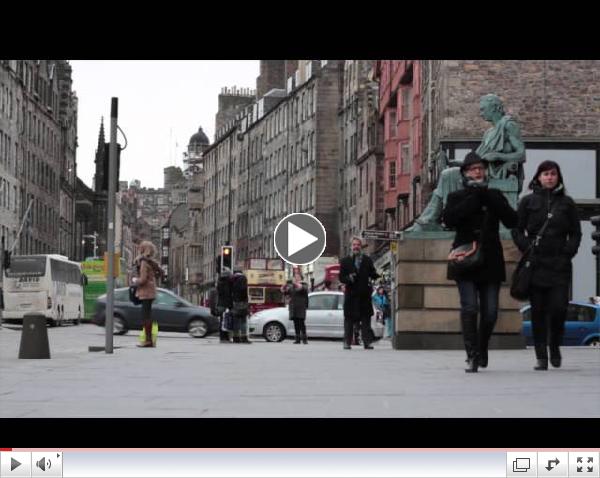
Click here if you'd like to hear my thoughts about this master of engaging with the media which were recorded in icy conditions on The Royal Mile.

Maximizing Your Free Media Publicity

Alex Salmond's rhetoric may not be quite as fiery as William Wallace's.

But he must still lie awake nervously wondering if Mel Gibson will be brought back to Scotland to portray him in a future movie.

And if you need reminding about what a fired-up Scottish-accented Mel Gibson looks and sounds like, then click here on this rousing excerpt from Braveheart.

THE BORIS BIKE CRASH

One person has done far less well in front of the cameras over the past week than either Alex Salmond or Mel Gibson.

This is London cyclist and Mayor Boris Johnson.

Mr Johnson gave a string of media interviews where he did far far far worse than he normally does.

Usually his endearingly bumbling but witty performances win over journalists and viewers alike.

But even faced with a bunch of school pupil interviewers as part of the BBC's "School Report" series, Mr Johnson failed to give a straight answer to a persisitent series of straight questions about his aspirations to become British Prime Minister.

During this interview - and others - Mr Johnson claimed his chances of becoming prime mininster were next to zero.

They weren't anywhere near zero before.

But they are now. 

Mr Johnson's worst performance was in an interview with the BBC's Eddie Mair where he managed to break practically every rule in the good interview response book.

If you can bare to watch the full bike crash experience it's at http://blogs.spectator.co.uk/coffeehouse/2013/03/boris-johnson-meets-his-match/

Among of the learning points from the Johnson interview experience are:

# Give straight answers - and don't do as Boris Johnson does at one point and ask for "permission to obfuscate".

# Go beyond just preparing for the obvious. Mr Johnson claimed he was expecting the questions to all be about housing and the Olympic legacy. Ask yourself: What else could be on the media radar? In this instance - given the speculation about Mr Johnson's prime ministerial ambitions - questions about his next job and his integrity could be reasonably expected.

# If you believe a question is not appropriate for you to answer explain, just why it isn't - and stick to your position. Mr Johnson tries a mixture of complaint about the questions, saying he doesn't want to talk about some subjects, giving partial answers but then claiming there isn't time for the full thing (there was plenty of time) and at one point offering a decidedly half-hearted apology (either give a full genuine apology or don't give one at all).

# Keep eye contact with the interviewer or you will look dishonest. Mr Johnson goes from having very good eye contact on the early softer questions and then repeatedly looks away on the challenging personal ones...signalling that he's being less than straight-forward.

To his credit, Mr Johnson did better after the encounter which has become known as the "bike crash" interview.

"I fully concede it wasn't my most blistering performance," he confessed, returning to his more normal candour.

The mayor's father, Stanley Johnson, complained that the interview was "the most disgusting piece of journalism I've listened to for a very long time".

But his son realised there was no mileage in joining such complaints.

"Eddie Mair did a splendid job," he declared.

"He was perfectly within his rights to have a bash at me - in fact it would have been shocking if he hadn't. If a BBC presenter can't attack a nasty Tory politician, what's the world coming to?"

Asked whether Mr Mair should get the job of presenting role on the BBC's flagship politician-grilling programme, Newsnight, Mr Johnson added: "I should think he'll get an Oscar."

That's more like it Boris...though I think you'll be hard pressed to repossess the "future prime minister" tag from here.

You should have paid more attention in your media training classes... though I wish to stress that I didn't train you!!!
THE DOUBLE ACT TO CHALLENGE FRED AND GINGER

And here's the good news for those wanting a high impact, high drama conference event with a difference.

I've teamed up with a rapidly rising star in the Professional Speaking Association, Nicci Roscoe, who specializes in helping people make a fabulous impact.

mike and Nicci
Picture Credit: Dianna Bonner http://www.worldvisionphotos.co.uk/ 

Nicci is one of those who truly lives the brand and tends to make a fabulous impact wherever she goes - including on a string of television on programmes like GMTV with Lorraine Kelly, Sky One's "One-To-Three", "Mind And Body" and "Weigh To Go".

We have several double acts which can run as interactive conference keynotes or as workshops for away days.

The first one to make its debut is "Making Your Team Look And Sound Great" which will run in the City of London in May.

On the "Look" side, Nicci gives practical guidance on how to look the part and, as a fitness guru, can advise your teams on how to get into top shape.

On the "Sound" side, we can show audiences how to boost the content, structure and performance of business introductions, presentations and answers to tough questions in professional situations.

One of the things we do on stage is to demonstrate good and bad practice.

So as something of an actress, Nicci can play the part of both excellent and appalling characters whether it's the bitchy job interviewer or the dragon around the boardroom table.

We demonstrate ways to win out in the kind tough situations which any particular audience has to face.

And when the conference crowd is brave enough, volunteers can come on stage to try out the best practice techniques in the spotlight - and get a personal critique everyone can benefit from.

We give audiences instantly useable takeaway guidance on how to deal with a whole range of difficult people.

This includes dealing with your organisation's own personal nightmares - whether they're challenging customers, skeptical prospects... or even BBC interviewers who are out to get you!

Keep smiling,

Michael 

Tuesday, 5 March 2013

OVERCOMING YOUR FEAR OF PREPARATION


FEAR OF PREPARATION 

Here's a scene I encounter pretty much every week.

There's a gathering of leaders...sometimes from the same company; sometimes from the same business leaders group.

They all say they're nervous.

And indeed they are.

They talk of sweaty palms.

They talk of shaking hands.

They talk of butterflies in the tummy.

Fear of Preparation  

They're about to have their communications skills tested - and taken to a new, more inspirational level.

It could be to make a presentation.

It could be do a brief business introduction.

It could be to answer tough questions.

What makes them even more apprehensive is the presence of the camera operator setting up in the corner.

There are surveys which show people fear speaking in front of audiences more than they fear rattlesnakes, death and going to the dentist.

But here's the crucial thing I've discovered.

What they really fear is not speaking in front of others - even the camera.

They fear PREPARING to speak.

And the reason they fear this is frequently because they don't know quite how to prepare.

When they're shown how to choose the right content and the right structure for those presentations, introductions and questions they feel so much better.

And as we spend the session focusing on how to prepare - and then actually preparing, it makes the world of difference.

Those business leaders who were so nervous feel so much better.

They prove to themselves they can actually do it - if they know how to prepare and then actually take the trouble to do so.

And when they know how best to stand, how to involve their hands and how to best utilise their voice, they feel still more at ease.

Those sweaty palms and shaky hands disappear.

And if there are any butterflies left, at least they're flying in formation.

There's more on "Presenting with Confidence, Impact and Pizzazz" at

AT LAST!!!

In many of the groups of business leaders I work with, the participants have to give the professional speakers who conduct the session a mark out of ten.

Your reputation as a speaker lives or dies by these marks.

And there's one brand of groups who actually pay the speakers in accordance with their score.


No pressure, eh?

But while the participants can be generous with their marking when they feel they've made great progress, it is - quite understandably - tough to completely satisfy everyone in a session.

So it was nice to finally hit the jackpot with a group outside Wigan where for once all members managed to give a score of ten out of ten. 
Wigan
Wigan in the English North-West
Three cheers for Wigan, Adrian Sharpe and members of his Vistage K231.

And a big thanks to all those chairs of business leaders groups and members for your constructive suggestions to put me on the right track over the past few years.

Alas the scores can only go down from here!!! 

ANSWER THE QUESTION MR BATES

It's fair to say that the Canadian company, Research In Motion, which produces Blackberrys is feeling the heat from its rivals Apple and Samsung after a massive loss in market share.

How do I know?

Not by studying the Blackberry figures, but by listening the interviews given by the company's European Managing Director, Stephen Bates.

When I say "interviews" I am using the term loosely.

Interviews traditionally involve actually responding to questions.

Mr Bates's approach to being interviewed is to avoid answering the question completely - time after time.

As a result he looks and sounds dodgy....as bad as the worst of politicians.

Viewers watching his performances can be forgiven for shouting at their TVs and radios: "Answer the question, Mr Bates."

Questioned about the delay in the launch of a new model Blackberry on BBC Breakfast TV, Mr Bates was asked repeatedly "What went wrong?"

His answers began variously with:

"Actually it's interesting..."

"So, so you know I'm always excited to be part of this ..."

"Traditionally, this is a great market..."

"This is a phenomenal market..."

You can re-live all Stephen Bates's non-answers at:


Mr Bates similarly evaded all questions on Radio 5 Live on the subject of what had Blackberry learned from the Apple iphone?

The conclusion you have to reach from all the non-answers is "Lots and lots and lots".

Judge for yourself at:

HOW YOU SHOULD TREAT THOSE QUESTIONS
  
If you want to come across as devious, slimy and insecure under pressure then copy the Stephen Bates technique whenever you're interviewed.

If you want to look honest, relaxed and in control then do what Mr Bates should have done: ANSWER THE QUESTION RIGHT UP FRONT.

Once you have answered the question, you then have a license under the normal rules of conversation to add a bit more - and convey an additional message.

But if you don't answer then your audience and the journalistic world will draw their own conclusion - which is probably far worse than any embarrassing truth.

You can get the Michael Dodd Communications free media interview tipsheet at


And if you want to be prepared for a media crisis, I have a way of bringing it to life through an unfolding series of mock media stories based on what your organisation would have to deal with if something goes wrong.

There's more information about master classes in media interview response at:

THE PRIME MINISTERS AND ME

I hope none of you missed the interview I did on Australian radio twenty years ago with then Canadian prime minister, Brian Mulroney.

In the unlikely event that you missed it, it was conducted in Munich where I was covering what was then called the G-7 conference of the leading economic nations.

Mr Mulroney was giving a press conference as a controversial Canadian domestic issue blew up involving French-speakings in Quebec - and only Canadian journalists were admitted.

mULRONEY
Brian Mulroney, 18th Prime Minister of Canada
The press conference went on ages and we journalists from other countries were locked outside listening on a speaker system, but unable to put our questions to the big man of Canada about issues important to our audiences.

Eventually the press conference ended and the Canadian journo's all rushed out to file their stories.

I stormed in and went up to Mr Mulroney saying "Canada locked Australia out of your press conference!"

He was apologetic, in a jovial kind of way, and asked me if I knew Bob Hawke - the then Australian Prime Minister.

As I had previously been a Canberra correspondent, I could tell him that I did indeed and had asked Mr Hawke many questions at many press conferences Down Under.

Mr Mulroney told me how much he liked Bob Hawke, and said that as I knew Mr Hawke he would give me my own exclusive interview.

He did it on the spot.

Brian Mulroney proved to be a fascinating, colourful and engaging interviewee (who actually answered the questions - Mr Bates take note).

My lords and masters at the Australian Broadcasting Corporation were very pleased with the result.

So I had a good, albeit narrow, perception of Canadian politics...until this week when I was sent the following story supposedly about the latest Canadian PM.

Please read it with a massive pinch of salt...


SPIN, CANADIAN STYLE (ALLEGEDLY)

Judy Harper an amateur genealogy researcher in Northern Ontario, was doing some personal work on her own family tree.

She discovered that Prime Minister Stephen Harper's great-great uncle, Remus Rudd, was hanged for horse stealing and train robbery in Winnipeg in 1889.

Both Judy and Stephen Harper share this common ancestor.

The only known photograph of Remus shows him standing on the gallows at Canada's Manitoba Provincial Jail.

On the back of the picture Judy obtained during her research is this inscription:

'Remus Rudd horse thief, sent to Stoney Mountain Jail 1885, escaped 1887, robbed the Canadian Pacific (Railway) and Canadian National (Railway) trains six times.

Caught by Mounted Police Force, convicted and hanged in 1889.'

So Judy recently e-mailed Prime Minister Harper  for information about their great-great uncle, Remus Rudd.

Believe it or not, Harper's staff sent back the following biographical sketch for her genealogy research:

"Remus Rudd was famous in Ontario during the mid to late 1800s.  His business empire grew to include acquisition of valuable equestrian assets and intimate dealings with the CP and CN Railways..

Beginning in 1883, he devoted several years of his life to government service, finally taking leave to resume his dealings with the railroads.

In 1887, he was a key player in a vital investigation run by the Mounted Police Force.

In 1889, Remus passed away during an important civic function held in his honour when the platform upon which he was standing collapsed."

It would be fascinating if this story were true.

Unfortunately, in my attempts to verify it, I came across an almost identical story on the web put up earlier about the former Australian Prime Minister, Kevin Rudd.

Here's a picture of Mr Rudd's supposed long lost relative being hung...or as Australian's were told "taking part in an important civic function in his honour."

Remus rudd  

It seems the Australian story is as untrue as the Canadian one.

But I hope you enjoyed it anyway.

Meanwhile, as the descendent of an Australian convict who escaped to New Zealand where he had children by a Maori (my great-great-great grandma), my policy is to reveal all on the topic of family skeletons.

The plus side of this true story means I may be entitled to fishing rights in New Zealand waters.

I've just had the pleasure of basking by Middle Eastern waters, on a mission in Dubai.

Michael in Dubai
Picture credit: Anthony Miles

But it's nice to have the option of making a living from the waters further south if the need arises.

So being truthful about the family history isn't always so bad.

Keep smiling,

Michael