Thursday, 28 March 2013

Free Media Lesson From Bonny Scotland

LEARNING FROM THE SCOTTISH MASTER 

Larger-than-life Scottish hero William Wallace and current Scottish First Minister Alex Salmond are both famous for their pursuit of Scottish independence. 

But their methods have been rather different.

William Wallace took the direct physical approach involving lots of horses, swords and spears.

He defeated the English army at the Battle of Stirling Bridge in 1297, but then lost in the Battle of Falkirk the following year.

Wallace was later captured near Glasgow and handed over to the King of England.

He was hung, drawn and quartered in 1305.

Then things took a turn for the worse.

When the big award-winning film was made of William Wallace's life (complete with various historical inaccuracies), he suffered the further indignity of being portrayed on screen by an Australian.

Braveheart
Mel Gibson as William Wallace in Braveheart
  
By contrast, Alex Salmond is alive and well.

As a result, he's able to play himself on Scottish television every night without the need for an actor imported from the southern hemisphere.


Alex Salmond  

Alex Salmond has just made his latest and rather more peaceful move towards trying to make Scotland an independent nation.

He's announced the date of the referendum which will take place on 18 September 2014.

The smart money suggests - at this early stage - that the majority of Scots will vote against independence...fearing, among other things, that Scottish oil won't be enough to sustain prosperity without English support.

As a communications professional, I'm naturally neutral on the issue of whether Scotland should depart from the United Kingdom (which, if it happened, would presumably mean the rest of the place would have to be re-named the Disunited Kingdom!) 

Mike at castle
An Australian tourist loitering outside Edinburgh Castle in the hope of being cast in the next big Scottish movie
 
Picture Credit: Jonathan Brind http://www.baa.me.uk/

But having met Alex Salmond and watched him deal with the media, I'd have to say: Don't underestimate his powers of persuasion.

Alex Salmond is a captivating political leader who is a master at engaging with the media on his terms.

Love him or loathe him, there's much we can learn from his approach to journalists.

When I met him during the first of his two stints as the leader of the Scottish National Party, I was far more impressed by him than I am with most politicians.

So working in Scotland this week, and watching Mr Salmond perform on Scottish TV, I've been reminded of just how charming and articulate he is.

Click here if you'd like to hear my thoughts about this master of engaging with the media which were recorded in icy conditions on The Royal Mile.
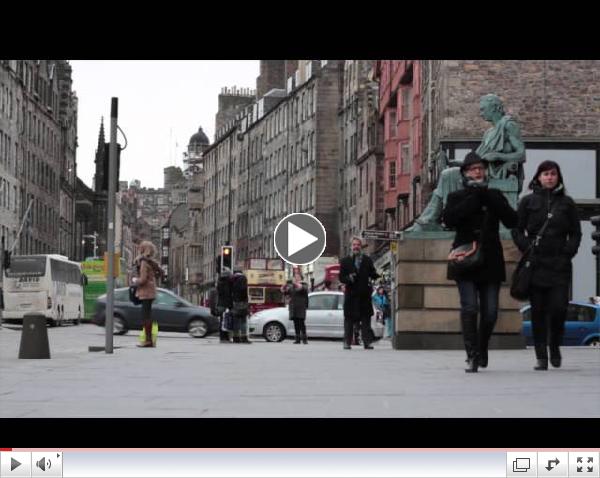

Maximizing Your Free Media Publicity

Alex Salmond's rhetoric may not be quite as fiery as William Wallace's.

But he must still lie awake nervously wondering if Mel Gibson will be brought back to Scotland to portray him in a future movie.

And if you need reminding about what a fired-up Scottish-accented Mel Gibson looks and sounds like, then click here on this rousing excerpt from Braveheart.

THE BORIS BIKE CRASH

One person has done far less well in front of the cameras over the past week than either Alex Salmond or Mel Gibson.

This is London cyclist and Mayor Boris Johnson.

Mr Johnson gave a string of media interviews where he did far far far worse than he normally does.

Usually his endearingly bumbling but witty performances win over journalists and viewers alike.

But even faced with a bunch of school pupil interviewers as part of the BBC's "School Report" series, Mr Johnson failed to give a straight answer to a persisitent series of straight questions about his aspirations to become British Prime Minister.

During this interview - and others - Mr Johnson claimed his chances of becoming prime mininster were next to zero.

They weren't anywhere near zero before.

But they are now. 

Mr Johnson's worst performance was in an interview with the BBC's Eddie Mair where he managed to break practically every rule in the good interview response book.

If you can bare to watch the full bike crash experience it's at http://blogs.spectator.co.uk/coffeehouse/2013/03/boris-johnson-meets-his-match/

Among of the learning points from the Johnson interview experience are:

# Give straight answers - and don't do as Boris Johnson does at one point and ask for "permission to obfuscate".

# Go beyond just preparing for the obvious. Mr Johnson claimed he was expecting the questions to all be about housing and the Olympic legacy. Ask yourself: What else could be on the media radar? In this instance - given the speculation about Mr Johnson's prime ministerial ambitions - questions about his next job and his integrity could be reasonably expected.

# If you believe a question is not appropriate for you to answer explain, just why it isn't - and stick to your position. Mr Johnson tries a mixture of complaint about the questions, saying he doesn't want to talk about some subjects, giving partial answers but then claiming there isn't time for the full thing (there was plenty of time) and at one point offering a decidedly half-hearted apology (either give a full genuine apology or don't give one at all).

# Keep eye contact with the interviewer or you will look dishonest. Mr Johnson goes from having very good eye contact on the early softer questions and then repeatedly looks away on the challenging personal ones...signalling that he's being less than straight-forward.

To his credit, Mr Johnson did better after the encounter which has become known as the "bike crash" interview.

"I fully concede it wasn't my most blistering performance," he confessed, returning to his more normal candour.

The mayor's father, Stanley Johnson, complained that the interview was "the most disgusting piece of journalism I've listened to for a very long time".

But his son realised there was no mileage in joining such complaints.

"Eddie Mair did a splendid job," he declared.

"He was perfectly within his rights to have a bash at me - in fact it would have been shocking if he hadn't. If a BBC presenter can't attack a nasty Tory politician, what's the world coming to?"

Asked whether Mr Mair should get the job of presenting role on the BBC's flagship politician-grilling programme, Newsnight, Mr Johnson added: "I should think he'll get an Oscar."

That's more like it Boris...though I think you'll be hard pressed to repossess the "future prime minister" tag from here.

You should have paid more attention in your media training classes... though I wish to stress that I didn't train you!!!
THE DOUBLE ACT TO CHALLENGE FRED AND GINGER

And here's the good news for those wanting a high impact, high drama conference event with a difference.

I've teamed up with a rapidly rising star in the Professional Speaking Association, Nicci Roscoe, who specializes in helping people make a fabulous impact.

mike and Nicci
Picture Credit: Dianna Bonner http://www.worldvisionphotos.co.uk/ 

Nicci is one of those who truly lives the brand and tends to make a fabulous impact wherever she goes - including on a string of television on programmes like GMTV with Lorraine Kelly, Sky One's "One-To-Three", "Mind And Body" and "Weigh To Go".

We have several double acts which can run as interactive conference keynotes or as workshops for away days.

The first one to make its debut is "Making Your Team Look And Sound Great" which will run in the City of London in May.

On the "Look" side, Nicci gives practical guidance on how to look the part and, as a fitness guru, can advise your teams on how to get into top shape.

On the "Sound" side, we can show audiences how to boost the content, structure and performance of business introductions, presentations and answers to tough questions in professional situations.

One of the things we do on stage is to demonstrate good and bad practice.

So as something of an actress, Nicci can play the part of both excellent and appalling characters whether it's the bitchy job interviewer or the dragon around the boardroom table.

We demonstrate ways to win out in the kind tough situations which any particular audience has to face.

And when the conference crowd is brave enough, volunteers can come on stage to try out the best practice techniques in the spotlight - and get a personal critique everyone can benefit from.

We give audiences instantly useable takeaway guidance on how to deal with a whole range of difficult people.

This includes dealing with your organisation's own personal nightmares - whether they're challenging customers, skeptical prospects... or even BBC interviewers who are out to get you!

Keep smiling,

Michael 

Tuesday, 5 March 2013

OVERCOMING YOUR FEAR OF PREPARATION


FEAR OF PREPARATION 

Here's a scene I encounter pretty much every week.

There's a gathering of leaders...sometimes from the same company; sometimes from the same business leaders group.

They all say they're nervous.

And indeed they are.

They talk of sweaty palms.

They talk of shaking hands.

They talk of butterflies in the tummy.

Fear of Preparation  

They're about to have their communications skills tested - and taken to a new, more inspirational level.

It could be to make a presentation.

It could be do a brief business introduction.

It could be to answer tough questions.

What makes them even more apprehensive is the presence of the camera operator setting up in the corner.

There are surveys which show people fear speaking in front of audiences more than they fear rattlesnakes, death and going to the dentist.

But here's the crucial thing I've discovered.

What they really fear is not speaking in front of others - even the camera.

They fear PREPARING to speak.

And the reason they fear this is frequently because they don't know quite how to prepare.

When they're shown how to choose the right content and the right structure for those presentations, introductions and questions they feel so much better.

And as we spend the session focusing on how to prepare - and then actually preparing, it makes the world of difference.

Those business leaders who were so nervous feel so much better.

They prove to themselves they can actually do it - if they know how to prepare and then actually take the trouble to do so.

And when they know how best to stand, how to involve their hands and how to best utilise their voice, they feel still more at ease.

Those sweaty palms and shaky hands disappear.

And if there are any butterflies left, at least they're flying in formation.

There's more on "Presenting with Confidence, Impact and Pizzazz" at

AT LAST!!!

In many of the groups of business leaders I work with, the participants have to give the professional speakers who conduct the session a mark out of ten.

Your reputation as a speaker lives or dies by these marks.

And there's one brand of groups who actually pay the speakers in accordance with their score.


No pressure, eh?

But while the participants can be generous with their marking when they feel they've made great progress, it is - quite understandably - tough to completely satisfy everyone in a session.

So it was nice to finally hit the jackpot with a group outside Wigan where for once all members managed to give a score of ten out of ten. 
Wigan
Wigan in the English North-West
Three cheers for Wigan, Adrian Sharpe and members of his Vistage K231.

And a big thanks to all those chairs of business leaders groups and members for your constructive suggestions to put me on the right track over the past few years.

Alas the scores can only go down from here!!! 

ANSWER THE QUESTION MR BATES

It's fair to say that the Canadian company, Research In Motion, which produces Blackberrys is feeling the heat from its rivals Apple and Samsung after a massive loss in market share.

How do I know?

Not by studying the Blackberry figures, but by listening the interviews given by the company's European Managing Director, Stephen Bates.

When I say "interviews" I am using the term loosely.

Interviews traditionally involve actually responding to questions.

Mr Bates's approach to being interviewed is to avoid answering the question completely - time after time.

As a result he looks and sounds dodgy....as bad as the worst of politicians.

Viewers watching his performances can be forgiven for shouting at their TVs and radios: "Answer the question, Mr Bates."

Questioned about the delay in the launch of a new model Blackberry on BBC Breakfast TV, Mr Bates was asked repeatedly "What went wrong?"

His answers began variously with:

"Actually it's interesting..."

"So, so you know I'm always excited to be part of this ..."

"Traditionally, this is a great market..."

"This is a phenomenal market..."

You can re-live all Stephen Bates's non-answers at:


Mr Bates similarly evaded all questions on Radio 5 Live on the subject of what had Blackberry learned from the Apple iphone?

The conclusion you have to reach from all the non-answers is "Lots and lots and lots".

Judge for yourself at:

HOW YOU SHOULD TREAT THOSE QUESTIONS
  
If you want to come across as devious, slimy and insecure under pressure then copy the Stephen Bates technique whenever you're interviewed.

If you want to look honest, relaxed and in control then do what Mr Bates should have done: ANSWER THE QUESTION RIGHT UP FRONT.

Once you have answered the question, you then have a license under the normal rules of conversation to add a bit more - and convey an additional message.

But if you don't answer then your audience and the journalistic world will draw their own conclusion - which is probably far worse than any embarrassing truth.

You can get the Michael Dodd Communications free media interview tipsheet at


And if you want to be prepared for a media crisis, I have a way of bringing it to life through an unfolding series of mock media stories based on what your organisation would have to deal with if something goes wrong.

There's more information about master classes in media interview response at:

THE PRIME MINISTERS AND ME

I hope none of you missed the interview I did on Australian radio twenty years ago with then Canadian prime minister, Brian Mulroney.

In the unlikely event that you missed it, it was conducted in Munich where I was covering what was then called the G-7 conference of the leading economic nations.

Mr Mulroney was giving a press conference as a controversial Canadian domestic issue blew up involving French-speakings in Quebec - and only Canadian journalists were admitted.

mULRONEY
Brian Mulroney, 18th Prime Minister of Canada
The press conference went on ages and we journalists from other countries were locked outside listening on a speaker system, but unable to put our questions to the big man of Canada about issues important to our audiences.

Eventually the press conference ended and the Canadian journo's all rushed out to file their stories.

I stormed in and went up to Mr Mulroney saying "Canada locked Australia out of your press conference!"

He was apologetic, in a jovial kind of way, and asked me if I knew Bob Hawke - the then Australian Prime Minister.

As I had previously been a Canberra correspondent, I could tell him that I did indeed and had asked Mr Hawke many questions at many press conferences Down Under.

Mr Mulroney told me how much he liked Bob Hawke, and said that as I knew Mr Hawke he would give me my own exclusive interview.

He did it on the spot.

Brian Mulroney proved to be a fascinating, colourful and engaging interviewee (who actually answered the questions - Mr Bates take note).

My lords and masters at the Australian Broadcasting Corporation were very pleased with the result.

So I had a good, albeit narrow, perception of Canadian politics...until this week when I was sent the following story supposedly about the latest Canadian PM.

Please read it with a massive pinch of salt...


SPIN, CANADIAN STYLE (ALLEGEDLY)

Judy Harper an amateur genealogy researcher in Northern Ontario, was doing some personal work on her own family tree.

She discovered that Prime Minister Stephen Harper's great-great uncle, Remus Rudd, was hanged for horse stealing and train robbery in Winnipeg in 1889.

Both Judy and Stephen Harper share this common ancestor.

The only known photograph of Remus shows him standing on the gallows at Canada's Manitoba Provincial Jail.

On the back of the picture Judy obtained during her research is this inscription:

'Remus Rudd horse thief, sent to Stoney Mountain Jail 1885, escaped 1887, robbed the Canadian Pacific (Railway) and Canadian National (Railway) trains six times.

Caught by Mounted Police Force, convicted and hanged in 1889.'

So Judy recently e-mailed Prime Minister Harper  for information about their great-great uncle, Remus Rudd.

Believe it or not, Harper's staff sent back the following biographical sketch for her genealogy research:

"Remus Rudd was famous in Ontario during the mid to late 1800s.  His business empire grew to include acquisition of valuable equestrian assets and intimate dealings with the CP and CN Railways..

Beginning in 1883, he devoted several years of his life to government service, finally taking leave to resume his dealings with the railroads.

In 1887, he was a key player in a vital investigation run by the Mounted Police Force.

In 1889, Remus passed away during an important civic function held in his honour when the platform upon which he was standing collapsed."

It would be fascinating if this story were true.

Unfortunately, in my attempts to verify it, I came across an almost identical story on the web put up earlier about the former Australian Prime Minister, Kevin Rudd.

Here's a picture of Mr Rudd's supposed long lost relative being hung...or as Australian's were told "taking part in an important civic function in his honour."

Remus rudd  

It seems the Australian story is as untrue as the Canadian one.

But I hope you enjoyed it anyway.

Meanwhile, as the descendent of an Australian convict who escaped to New Zealand where he had children by a Maori (my great-great-great grandma), my policy is to reveal all on the topic of family skeletons.

The plus side of this true story means I may be entitled to fishing rights in New Zealand waters.

I've just had the pleasure of basking by Middle Eastern waters, on a mission in Dubai.

Michael in Dubai
Picture credit: Anthony Miles

But it's nice to have the option of making a living from the waters further south if the need arises.

So being truthful about the family history isn't always so bad.

Keep smiling,

Michael

Monday, 28 January 2013

MAD MEDITERRANEAN MONKEY MAULS MICHAEL

THE KEY TO GETTING FREE PUBLICITY

The art of getting free media coverage for your organisation largely depends on coming up with what journalists regard as REAL NEWS.

So when I'm showing people during master classes how to achieve this, I seek to get them inside the mind of the journalist.

Journalists don't see the world in quite the same way as other people do.

They know REAL NEWS when they spot it - even if they can't eloquently define it.

Alas many other people are totally unable to fully grasp what is news...as reflected in so many badly written press releases which hit the metaphorical cutting room floor in newsrooms around the world.

When you know what real news is you're a long way down the road to getting loads of free publicity.

The traditional definition has it that when a dog bites a man it's probably not news.

This is because it happens too often.....and only becomes news if it's a particularly ferocious attack or if the dog belongs to a celebrity.

But if a man bites a dog, that is news.

That's because it's rare.

In this ezine we are going a step further with our own MONKEY BITES MAN story.

mean monkeys  

Now this is particularly big news - because that man was me!

It happened on The Rock of Gibraltar - during an otherwise fabulously enjoyable professional speaking mission.

There's more on the infamous monkey bite later.  

Micahel on the rock
Crime scene: Rock of Gibraltar where the bite took place

WHAT MAKES NEWS?

There is a formula for what makes news which is easy to remember.

It revolves around the fact that, journalists are always after is one thing - TRUTH.

Yes, really!!!

The TRUTH formula is as follows:

Topical: If something is running in the news - say the French troops in Timbuktu or the debate on whether Britain leaves the European Union - then if you have a story which touches on that in some way the media will probably be interested.

Relevant: If you present a branch of the media with something that is relevant to their particular audience then they should be interested. The bigger the impact on their audience - emotionally or economically - the more attracted they'll be.

Unusual: This is the "Man Bites Dog" factor....or for the purposes of this newsletter "Monkey Bites Michael" factor.

Trouble: The media love trouble and controversy. So anything that touches on this should spark their interest. This is a potentially dangerous factor though, as you don't normally want your organisation seen as being a trouble-maker. Better to portray yourselves - if the facts allow - as the trouble-solver.

Human: People love stories about people....particularly interesting people. Welsh ballboy Charlie Morgan has been kicked by a Premier League football player, aptly named Hazard, which has resulted in phenomenal interest in the
humans involved in the drama.

So if your potential story doesn't hit any of these factors it may not be worth sending out a press release out about it.

Instead, look for something that hits one or preferably more of these "TRUTH" factors and you're in with a chance.

There's much more information about getting free media publicity for your business in an interview I did with a round-the-world radio station - Voice America - hosted by international radio star Chris Cooper.

It's an hour-long interview which explains how to project your message through radio, television, newspapers and news websites.

You can hear it at:


Details about my master classes on "Position Your Business For Free Media Publicity" are at:


MEANWHILE BACK AT THE ROCK...

Despite being only the ninth biggest rock in the world (way behind Australia's Uluru in the Number 1 Spot and not doing anything to improve its position), Gibraltar has a lot going for it.

Great winter sunshine, spectacular views and - as professional speakers really appreciate - top audiences.

One particular audience I encountered was especially interesting...though it has to be said not all that well-behaved at times.

But audience members made up for it by throwing themselves wholeheartedly into the learning exercises.

Here's tribute to the audience for my big talk on top of the Rock.

And if you keep watching after the closing credits there's a bizarre sequence which will be explained later.

Communications-Boosting Speaker Michael Dodd Finds Perfect Audience

This audience took a pick-and-mix approach to my professional speaking offerings.

If you have a conference coming up, you may want to choose more selectively from the full menu of interactive keynotes.

# BECOMING INSPIRATIONAL BUSINESS COMMUNICATORS

# HAVE I GOT NEWS FOR YOUR COMPANY - PREPARING FOR MEDIA EMERGENCIES

# MASTERING THE MEDIA - WITH BALLS

# YOUR 2013 MESSAGE ACROSS IN SIXTY SECONDS

# GIVING GREAT ANSWERS TO TOUGH QUESTIONS

Details of the keynote options are set out at:
http://www.michaeldoddcommunications.com/international_speaking.php


PUTTING THE BITE ON TOURISTS

So here's how the big moment happened.

My camera operator and I had trudged and sweated our way to the summit of The Rock when a tour bus drove up.

The monkeys were very excited to see the driver for whom they clearly had a certain affection.

It became obvious that - despite signs across The Rock warning not to feed the monkeys - the driver had managed to make himself a hero of the wildlife community by hand-feeding them nuts.

The monkeys gathered on the roof of his bus, and when tourists put their arms out, they would spectacularly leap onto them - to be rewarded by the driver.

This got the monkeys (and the tourists) increasingly excited.

So I was persuaded that having a monkey leap upon me seemed like a good idea at the time (the so-called streaker's defence).

And shortly after outstretching my arms I was blessed with a giant leap of a seemingly lovely, almost cuddly, though rather hefty monkey who landed with bang.

He then made his way down to my hands.

And perhaps disappointed that there was no nut to be found there, he proceeded to sink his teeth into my finger.

There was blood...though admittedly not that much.

You can just about see the gory detail in this picture if you look closely.

Ape sign  

So the person who said never perform with children and animals knew what he was saying.

But at least it gives me another story for my after dinner speech on "Tales and Tips from Six Continents"

THE AFTERMATH

You'll be ecstatically relieved to know that there've been no side-effects from the monkey bite so far.

If you see me frothing at the mouth during my next conference speech, that's just natural Australian exuberance - not rabies.

Apparently the potential danger from a Gibraltar monkey bite is actually tetanus.

But my doctors' surgery assured me that, having had a tetanus jab in 2005 which lasts ten years, I'm in the clear.

At this point I should pay tribute to our charming and dynamic Gibraltarian host, Pete Yeoman, who looked after us, ferried us diligently between speaking engagements and kept us fully entertained.

However Pete does take rugby seriously, and as an Englishman who has a close interest in the forthcoming Lions Tour, he does perhaps have less sympathy for Australians than you might imagine.

Nonetheless he's even trying to line up engagements for my next Gibraltar speaking excursion.

Pete - who is pictured here at the foot of the Rock - was the first to send a text message when the monkey bite news got out.

Michael and Peter  

I keep it on my phone for sentimental purposes.

It says: "Hope the ape survived!!"

Keep smiling,

Michael

Wednesday, 2 January 2013

THE COMMUNICATIONS CHALLENGE OF THE DIGITAL REVOLUTION

As we zoom into another year of the digital revolution, people have more and more sources of easily-accessible information.

This is a fantastic thing.

But it gives rise to the biggest business communications challenge of our age.

How do we grab and keep our audience when we're competing for attention with an ever-exploding number of information sources?

And how do we get our message across when - as a consequence of the upsurge in available information - our targets have less and less time to listen to us?

This challenge is reflected in the media world by the ever-diminishing length which television gives people to make their point in news reports.

In America, where they make a point of studying such things, the typical length of a "sound bite" on television - the time the news bulletin gives to a person being interviewed - has fallen from forty-three seconds in the 1960s to nine seconds now.

sound bites  

This has unkindly been interpreted as part of a "dumbing down" process by the media.

But you can also interpret it as meaning audiences are becoming more discriminating, and so are inherently gravitating to information packaged in more easily digestible chunks.

Whether we are trying to get across a message on TV or face-to-face or through the internet, we're faced with the challenge of making our point in a shorter, punchier more memorable way than was previously necessary.

And in the business world, getting across your message is something you must do - amidst this tougher competition in the information market place.

As the American businessman, Lee Iacocca, observed "You can have brilliant ideas, but if you can't get them across, your ideas won't get you anywhere."

Of course it often takes more time and thought to ensure that our message is constructed in a more succinct and impactful way.

It's a truth Mark Twain noticed when he confessed: "I did not have time to write a short letter, so I wrote you a long one."

These days, time constraints and digital competition mean most long versions just don't stand a chance.
MAKING YOUR POINT - IN TIME WITH TOAST

Having been mulling over the challenge of getting through to ever-busier audiences, I've come up with a new offering for the year.

It's called "Your 2013 Message In Sixty Seconds".

The idea is to help you make your point in a more powerful way - in the time it takes to cook a piece of toast.

There's a keynote version for conferences - so audiences leave better equipped to hit their targets in the information jungle.

This can involve a few volunteers on stage who we work on to sharpen their sixty- second messaging as the keynote progresses.

Their improvement levels are measured by audience votes.

And there's a half-day master class version for business leaders and
others.

In these workshops, every participant can leave knowing that in their next professional conversation, meeting or webcast they can make their point more succinctly and effectively - and in a way that sticks.

As a primary school student, I remember being taught how to put bread in a pop-up toaster and being told it would take a minute to turn brown.

So putting this to the test, I've recorded part of my 2013 new year message with some timing assistance from the Dodd family toaster.

Having said that, if you study it with a stop watch in hand, you might find the Dodd toaster takes slightly more than 60 seconds to deliver the goods.

But here's hoping it's nonetheless helped produce a crisp, tasty, bite-sized message.
 
 The full range of communications-boosting master classes is here.


POLAND TWENTY-FIVE YEARS ON

I've just been helping to run communications skills sessions in Poland - a country which has undergone an amazing transformation over the past quarter of a century.

Compared with my first visit there in 1988, it's now amazingly well-organised, efficient and creative.

On my first mission to Warsaw during the Cold War there were long, miserable queues in the streets for food; shoddily built and badly-maintained apartment blocks and communist secret police who would monitor and sometimes attack those who took on the system.

When I arrived in Warsaw Airport twenty-five years ago it was a grim, forbidding place.

This time it was so vibrant, the airport arrivals hall was being used as a movie set - with participants only too happy to explain what was going on as they awaited their moment in the spotlight.

Poland movie  

At the airport and beyond, Warsaw proved to be hugely cleaner and better maintained - with far more freedom than on my initial visit when, as a foreign journalist, I was trailed by secret police.

It was of course Polish campaigners for freedom who did more than anyone else to bring an end to the communist dictatorship imposed on Eastern Europe by the Soviet Union.

So when I was able to travel to Gdansk in the north to do an interview with Lech Walesa - the leader of Poland's Solidarity Free Trade Union - it was of interest to the secret police as they fought to suppress the union's heroic efforts to overturn the system.

Getting to meet Lech Walesa - at a time when a new wave of coal miners' strikes was kicking off - was a highlight of my 1988 visit.

But there was one character who stood out even more than the man who went on to be the first fully democratically-elected Polish president.

This was another Solidarity activist called Jacek Szymanderski who was regularly put in jail for his pro-freedom activities. 
Jacek
Jacek Szymanderski, left, in a 1989 election campaign poster with Solidarity leader Lech Walesa in historic elections which helped free Eastern Europe
Conditions in the jails run by the Polish communists were not great, as you might imagine, and the food was normally dire.

But I particularly remember Jacek telling me in his vibrant, broken English how on one occasion in 1986 he and his fellow inmates were surprised that instead of the usual drab food they were suddenly given lettuce.

"Great leaves of salad," was how he excitedly described them.

This was a particularly rare treat as even Poles outside of jail found fresh produce extremely hard to come by.

The prisoners devoured the lettuce leaves with gusto.

But afterwards they experienced what Jacek colourfully described as much "vomitation".

It was only later the democracy-campaigners found out where the lettuces had originated.

It was a place called Chernobyl.

They'd been exported to Poland from the Ukraine in the immediate aftermath of the world's worst nuclear accident there.

Jacek's story is among those I tell in my new after dinner speech called "Tales and Tips from Six Continents".

More details in the After Dinner Speaking section at:

http://www.michaeldoddcommunications.com/international_speaking.php
THAT'S NOT A ROCK!!!

I'm looking forward to my first international mission of 2013 - next week in
Gibraltar.

Given the British territory's location on the southern coast of Spain, temperatures are bound to be higher than we're experiencing in wintry London at present.

I'm fortunate enough to be going there courtesy of the Academy for Chief Executives.

I await with much anticipation my first view of the Rock of Gibraltar - which I'm sure you'll agree looks pretty magnificent.

rock of gibraltar  

In the world rankings of monoliths (big rocks, to you and me), The Rock of Gibraltar rates as the ninth largest in the world.

Mind you, I will have to be careful what I say about it.

Coming from Australia - the land of earth's biggest rock - I might be tempted to scoff at the size of Gibraltar's.

You may recall the Australian movie character, Mick "Crocodile" Dundee, famously and disparagingly saying to a would-be New York mugger "That's not a knife" while producing his own much larger weapon.

I was thinking of taking a picture of Uluru - the seriously large rock pictured below - and saying to Gibraltarians about their pride and joy: "That's not a rock".

Uluru  

If you need a reminder of how Australian's can drop in such a line with masterly understatement, click here.


Wishing you the rocks you deserve in 2013.

Keep smiling,

Michael